Hello everyone, and welcome to another System Spotlight! We’re talking about superheroes in this issue, so time to don our spandex and kick some badguy butt as we take a look at the official Marvel Multiverse RPG, written by Matt Forbeck and illustrated by Mike Bowden!
So, I’ll get to the system itself in a minute, but first I want to ramble a bit because I have a history with superhero RPGs. My group and I used to have a supers game a long time ago using the GURPS system and its Supers rulebook. For what it was, it was a really robust system that gave us all the flexibility in the world to create whatever superheroes we wanted. Sure, there were other systems at the time that were perhaps better suited for the task, like Hero System or Mutants & Masterminds, but we already used GURPS for everything, and it could basically handle anything we threw at it.
And just as a small side thing, I have a love/hate relationship with GURPS, more leaning towards hate to be honest, so it is unlikely I will ever do a System Spotlight on it unless y’all really want me to. I’ve pretty much decided that I only want to showcase systems that I like and can get excited about, and GURPS just frustrates me anymore.
Any which way and how, like many campaigns, our supers game fell apart after a number of years due to interpersonal conflicts and a general fracturing of the core group as people went about their lives. We always wanted to return to it, but convincing new people to play GURPS is like pulling teeth, so we went looking for other, simpler options.
Our GM was at GenCon last year, and he stumbled upon a table for Marvel Multiverse, an official Marvel RPG with an easy to learn system, some unique mechanics, and robust character creation that pulls from the MANY superheroes across the multiverse. He spent some time talking with the creators, chatting about our campaign and the things he wanted to do, and came away convinced it was the right game for us. And after having read the book myself and played in a recent one-shot game, I’m inclined to agree.
Core Mechanics
So, let’s talk about the game already! Marvel Multiverse is a 3d6 system that has you roll against a target number to determine if you succeed. Well, technically the game refers to it as d616 as the dice are a bit funky in ways we’ll touch on later and the game takes place on Earth 616, but it’s still basically 3d6. Pretty normal so far, for the most part. But what makes MM special is its dice. One of the dice is red and is the Marvel die, and on its 1 face is an M. If you roll the M on the Marvel die (or a 1 on a normal d6 if you’re using one), you get a Fantastic result. Depending on whether the roll was a success or failure, it becomes a Fantastic success or Fantastic failure. Fantastic Successes are a “Yes, and” result (you succeed and something else good happens) while a Fantastic Failure is a “No, but” result (you fail, but something good still happens). Love a “fail forward” mechanic. But the best possible result you can get is a six on two dice and the M on the Marvel die, which is always a success no matter the target number and makes the impossible possible.

Something else I want to touch on that I think is really neat is Edges and Troubles, MM’s version of 5e’s advantage/disadvantage that has wormed its way into many RPGs over the years. No complaints here, I think it’s great. Anyway, Edges and Troubles work a little different than you might expect. If you have an edge, you can reroll any single die when you make a check or attack, even the Marvel die, taking the best result. There’s some fun strategy here. Do you reroll a low roll to more likely succeed, or do you go for the Marvel die with the hopes of getting a Fantastic result? Love me some “crit fishing”. But if you have trouble, you must reroll your highest die and keep the lowest result.
Something else that separates this system from others of its kind is that Edges and Troubles stack. They still cancel each other out, but if you have more of one than the other, then you still keep whatever is left. So if you have 2 Edges but 3 Troubles, then you have 1 Trouble. I love this, as I’ve always thought it was dumb that Advantage and Disadvantage don’t stack in 5e, and most games continue to do it that way. Good on you, Marvel, for bucking the trend.
Karma
Karma is a special resource all characters have that is like D&D’s Inspiration in a lot of ways. Each hero has an amount of Karma equal to their rank, which refreshes each day. You can gain more Karma by doing cool stuff and being heroic, or for whatever reason the GM (or Narrator) feels like. You can spend Karma to gain an Edge on a single roll, impose Trouble on an opponents roll, and some other ways like regaining lost hit points or Focus. Not much else to it!
Character Creation
With the basics out of the way, let’s jump to character creation. First, you’ll choose your Rank. The rank of your hero (or villain if that’s the kind of game you’re running) gives you a general idea of how powerful they are and also will determine other things throughout character creation like points for stats and powers. For reference, your basic henchmen or civilian would be Rank 1 while Rank 6, the highest rank, would be someone like The Hulk or Magneto.
MM has six attributes: Melee, Agility, Resilience, Vigilance, Ego, and Logic, which yes, spells Marvel. Certainly makes them easier to remember. You then get a number of points based on your rank to increase those attributes, up to a limit based on your rank.
Backstory
Now we get to figure out our hero’s Backstory. Your backstory is made up of your Origin and your Occupation, so where your power comes from and what you do for a living. Your Origin could be Alien like Martian Man Hunter, High Tech like Iron Man, Mutant like any of the X-Men, or any of the wide variety of possible origin stories from throughout comics’ history.
Each Origin gives you Tags, Traits, and sometimes Powers. Tags are just descriptors for your character and rarely have any sort of mechanics tied to them (Heroic specifically, I think), while Traits are mechanical benefits or drawbacks appropriate to the Origin. For example, the High Tech: Battlesuit origin that Iron Man has gives the Extreme Appearance Tag, which just means you stick out and are visually distinct, and the Tech Reliance Trait, which lets you sacrifice all of your powers that rely on technology to not go down when knocked to 0 hit points.
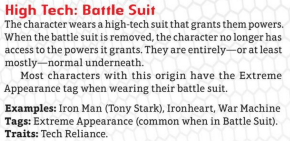
Something to keep in mind for powers given by an Origin is they aren’t free. If you choose an Origin with powers, you must take them first before taking other powers during character creation. Still not sure how I ultimately feel about this, as normally in most games you would just get something like that for free so it would be nice if you at least got them at maybe a discount or something, but I bet it’s that way for balance reasons, so I’m not too broken up about it.
Now for your Occupation! This is pretty self-explanatory, it’s what your character does for a living, and much like your Origin, each Occupation also gives you some Tags and Traits. There’s an occupation for just about everything, at least in terms of major jobs represented in the comics. You could be an Educator like Professor X, a Journalist like Eddie Brock, Military like Captain America, or a Scientist like Mister Fantastic, just to name a few.
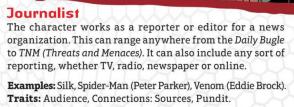
With your Origin sorted, you get to pick any Tags and Traits of your choice to further customize your character. You can pick any number of Tags you want, and you gain a number of additional Traits equal to your Rank.
Powers
And now for what makes you super, it’s time to pick your powers! Powers are divided into thematic categories called Power Sets, such as Elemental Control, Magic, Super-Strength, or Spider-Powers. You can choose a number of powers up to four times your Rank, and should you have any “points” left over, you can spend them to get additional Traits or increase your attributes at a 1-to-1 cost, which is pretty neat.
Many powers have prerequisites, such as requiring you to be a certain rank, be of a certain Origin, have a certain Tag, or take another power in the same set first. For example, to take the Darkness power, you have to be Rank 2 and take the Illumination power first.
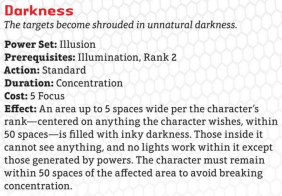
Another fun thing about powers is you actually get rewarded for sticking with fewer power sets. If you use fewer power sets than your rank, you get what’s called a Thematic Bonus, which is your rank minus the number of power sets you used, which you can use to take even more powers. So while you can take any powers you want, you’re encouraged to specialize.
As far as using powers goes, it’s pretty much a mix of feats and spellcasting in DND in a lot of ways. There’s a dedicated action for using them, they have a duration, a range, require either you or your target to make a roll, and some even require concentration to keep them going. The rest are just passive benefits you just always have. Many powers also require you to spend Focus, which is a special resource that also kind of acts like a second health pool, but I’ll go more into detail about that in the next section.
With powers chosen, now it’s just the rest of the usual character creation bookkeeping to deal with like hit points, focus, speed, and personal details like your identity (secret or otherwise), personality, team, and so on. And now your hero is ready save the day!
Combat
If you’ve played D&D then MM’s combat will feel very familiar. You roll for initiative and on your turn you have an action, movement, and reaction. It’s in the details where things get interesting. For example, if you get a Fantastic result on your initiative roll, you get to take part in a bonus round that takes place before everyone else, which is a fun idea. I wonder how well such thing would work in D&D, rolling a nat 20 giving you a bonus round? Could be a fun experiment.
Damage is also handled in an incredibly interesting way. When you make an attack, and you score a hit, the damage is determined by the result of the Marvel die. But it gets weirder. The Marvel die result is actually multiplied by your rank, and that multiplier is increased based on the weapon you use and other things like powers and traits. You’d think this could quickly get out of hand but bonuses to your damage multiplier don’t stack, you just take the highest source, kind of like temporary hit points in D&D. For example, I make an attack and roll a 4 on the Marvel die. My rank is 2, and lets say I’m using a sword, which has a multiplier bonus of +1. This makes my damage 4x(2+1), which is 12.
So what about taking damage? Well, damage comes in two forms, physical and mental. Physical damage is what you would expect, and most things do physical damage. Mental damage is where things get interesting. Remember Focus? Well, it basically represents your mental stability and some powers deal damage to it instead of your body. If you’re reduced to 0 Focus, you become Demoralized, which makes you immediately stop concentrating on powers and you gain Trouble on all checks. If you’re ever reduced to negative your max Focus, you basically go into a coma from mental trauma. Physical health is the same way, reduced to 0 you go Unconscious, reduced to negative your max HP, you die.
The last interesting thing I’ll talk about in regards to damage is lethal vs. non-lethal damage. Generally, superheroes don’t kill people, or at least they try not to. If you have the Heroic tag, your damage by default is non-lethal and you will always knock out your enemies rather than kill them unless you explicitly state otherwise. Now obviously that might take some kind of justification and handwaving depending on how you’re dealing damage, and there are some circumstances where deaths are inevitable, but generally you don’t kill people unless you’re trying to.
Team Maneuvers
Superheroes tend to be part of a team, like the X-Men or the Avengers, and in MM this gives you access to Team Maneuvers. We didn’t have the chance to mess with these in the one-shot I played since we weren’t a team and it was our first time playing, but here are the basics. There are 3 types of maneuvers: Offensive, Defensive, and Rally. At the start of an adventure, your team can choose a maneuver. You can change you maneuver once per day whenever you have a safe space and ample time to talk strategy. Once per combat at the start of the round, you can use your team maneuver, which either has an immediate effect or lasts until the next round. To use the maneuver, everyone in the team has to be within range and be able to communicate freely. Each member also has to pay a focus cost. The stronger the maneuver, the more focus it costs. And that’s pretty much it!

Expansions
As of writing this, there is one expansion currently available that focuses on the X-Men part of the greater Marvel umbrella. I’m not much of an X-Men person myself but I was curious enough to grab a copy of it and see what all it has to offer. There is also an upcoming Spider-Verse expansion slated for March of next year that looks pretty interesting, so I’ll likely be getting it too because I have a problem.
Anyway, the majority of the current expansion is X-Men lore, talking about mutants, the various teams and organization, Professor Xavier’s school, and the other worlds that feature mutants, as to be expected for an X-Men sourcebook. The rest of it new rules and content. There are new Team Maneuvers, rules for mutant schooling, new equipment and vehicles, new condition, rules for psychic duels, a whole section for the X-Men’s Danger Room (think Star Trek Holodeck for training), special drugs and diseases, new Origins, Traits, Tags, Power Sets, and Powers, and some special things called Narrative Powers. Pretty solid chunk of content.
Quick review, if you like X-Men, I think you’ll love this. Personally, I don’t regret buying it but it wasn’t what I had hoped for. My biggest gripe with it is a not insignificant amount of the mechanical content is restricted to mutants and is basically unusable in the greater game unless you’re running mutant character. Sure, you could always remove that restriction in your home game, who’s going to stop you, but it would have been nice for more of it to be more generally applicable. But, the things in the book that anyone can use are very much welcome additions, like the new power sets and powers, and I’m not above homebrewing my own solutions, y’all know this. So yeah, not what I was hoping for, but I’m still glad I got it.
Final Thoughts
So, what do I think about Marvel’s latest foray into the TTRPG space? I really like what they’ve done here and I’m incredibly excited to start making characters for the eventual return of the First Watch (our own supers group). There are a lot of familiar things with other systems I and many of my friends have played so it was easy to pick up, but there are plenty of other unique things that really grabbed me. I love how flexible the system is to really let you create whatever kind of hero you want, and I think the game does a great job at making you feel powerful and heroic. The d616 system is odd but unique and interesting, and I love the way damage is handled. Edges and Troubles stacking is great and frankly should be normalized for other similar mechanics. I really don’t have much to complain about that isn’t nitpicking, I just want more content.
I’m really excited to see where the game goes from here and what sort of new content they come up with for it. I imagine it will be more sourcebooks like the X-Men one, but personally I’d like to see more general player-facing content like Powers, Traits, and Team Maneuvers. The game is young, so we’ll just have to wait and see! I definitely recommend Marvel Multiverse if you’re looking for a superhero TTRPG.
One final thing before I close out this system spotlight, while I wholeheartedly recommend Marvel Multiverse, I would be remis if I didn’t mention a glaring issue with how one might go about purchasing it. For some absolutely insane reason, Marvel refuses to sell PDFs of this game. The only way you can purchase it is physically, in e-book form through Amazon, or the module for Roll20 or Demilplane. This is so infuriating as most companies in the TTRPG space understand just how valuable a PDF copy is. Hell, most of them will give it to you for free if you buy the physical book! I don’t have a solution so all I’ll say is support your local game stores if you can and y’all are a clever bunch, I’m sure you can find it in other places.
So yeah, thanks for listening to me ramble about a new game I’ve fallen in love with! Anyway, that’s all for now. As always, stay safe, don’t forget to love each other, and I’ll see you again soon.

 The Foundry
Leave a comment